Friday, February 19, 2016

Expansion


In my last blog post, I talked about how the 828 house was “Mom’s domain.” Another way of saying this is “Mom ruled the roost.” When I think of Mom, the word ‘rule’ often comes to mind. 
She seemed perfectly fit for the task of making and guarding a roost, a nest, a brood house where we 12 chicks could learn to be roosters and hens before heading out into the big world. By working energetically themselves and by assigning jobs to us kids, our parents created a clean, safe refuge where we could come of age.

Writing this I thought, “No, that’s not right!” Although not realizing it at the time, when I left home at age 18, I was utterly unprepared to live in the world. Eventually I came to believe that “Mom and Dad didn’t get me ready for shit!”

 I was socially awkward, crippled by shyness and inhibitions; unable to play the “dating game”, I joined a seminary. Although not realizing it when I first left home at age 18, I certainly didn’t have what it took to navigate the world. Nor did I at 23, when I was drafted into the army. Not at age 28, when I was first married. Nor at 30, when I became a parent. It pains me to admit how totally unprepared I was to relate to others—to my son especially, and to my wife, to my coworkers, to everyone except my siblings.

Looking back, I see how becoming a parent gave me my first dose of genuine responsibility. Someone was depending on me, not only for food and shelter (I had those areas easily covered), but also for his self-esteem and as a model for manhood (which I didn’t have covered).

Talking with my brothers and sisters (not all at the same time nor to the same depth), I began to figure out who I was and who I wasn’t. It was they who first helped me keep the possibilities of living as an adult life alive. (Later, when I remarried, my wife Mary Ann played a part in this, as did true friends whom I confided in.) It was all these people who encouraged me to seek professional (and unprofessional although not inferior) counseling and make changes in my life.

And it was much, much later that I came to realize that it was my parents who ultimately planted the seeds that would help me emerge from under my basket. (How I got under that basket is for a later blog post.) By assuming that we boys would go to college (the girls went too, although that wasn’t necessarily assumed), they planted in us the ability to grow after high school, not under their supervision, but under our own.

I came to see how we kids came to inherit Dad’s curiosity about the universe. And how we absorbed Mom’s interest in people and places and language. This inheritance allowed us to expand beyond 828.

In retrospect, I see how our parents taught us to be self-sufficient and independent, even (especially) in our thinking. Although some of us strayed from their teachings (on religion, lifestyle, politics, etc.), we never strayed from their idea that we were a family, and that we would always be a family. (Of course from time to time many/most/all of us kept our distance from 828 and the family in order to gain perspective and to just back away from the intensity.) And they taught us that life could be enjoyable – this allowed us to relax a little and to not be afraid of life. All of this was no small gift.

So I’ll just end this with, Thanks, Mom and Dad.


Bob

Thursday, December 3, 2015

Sharing Stories: A tie that binds


The 4Gs: George, George, George & George

I’m a grandmother now, the ninth of my twelve siblings to add to the next generation of Kerbers, even though my grandson’s surname is Schmitmeyer. But his given name is George, a Kerber name, making him one of four living Georges in the family. There is my younger brother George, who was named for our father, and two nephews, the sons of brothers George and John, and my grandson, George Simon Schmitmeyer, who is three months old.
 
I was happy about his given name, of course, and when my grandson is a little older, I’ll want him to know about the extended family into which he was born. Knowing familial connections helps us feel grounded; they make us feel part of something greater than ourselves. 
Our father, the original George

A way of nurturing family connections is through sharing stories, something our family has done in various ways through the years. Most recently it has been with this blog, but there have been other ways, too.

After Dad died and Mother decided to move out of 828 Spruce Street—almost forty years after she and my father moved in. Our family had a house-leaving party to divvy up the family artifacts, but also to say good-bye to the place we once called home. The get-together was held Thanksgiving weekend in 1988, and to commemorate the occasion, Mother asked each of us to write down our thoughts about 828, which we shared at the party. As you can imagine, there were lots of tears and laughter as we read what we’d written.

Thanksgiving 1988, toasting good-bye to 828 Spruce Street
There have been other ways of telling family stories through the years. As we kids grew up and moved away (we now live in six different states), we circulated a family newsletter for a couple of years. Called the Zweibach Times, it contained family updates and was named for the after-school snack Mom made from stale bread. (Zweibach is German for twice-baked, and she’d heat the bread pieces in a low oven for a long time and serve them warm with butter.)

It was Mom who, by example, encouraged our family’s writing. When each of her grandchildren turned sixteen, she wrote them a story about her life as the oldest of eight children growing up during the Depression. She told of the houses she lived in, the games she played, the horse-drawn buggy she rode to church in, even of living with my two oldest brothers in San Diego where Dad was stationed during World War II. Like the Zweibach Times, her birthday letters serve as a link to our family’s history.
Liwwät tombstone at St. John's

But the idea of recording life’s daily events can be traced deep within Mother’s heritage; her great, great grandmother was Liwwät Böke, a pioneer woman whose writings and drawings were published by the Minster, Ohio, Historical Society in 1987. The book, Liwwät Böke, 1807-1882, Pioneer, is a detailed account of everyday farm life in the mid 1800s. For many years, Liwwät wrote and drew pictures on the sheaves of paper she brought with her from Germany. In her writings, she tells of her passage to America and the challenges she and her husband Natz faced farming the dark wooded land near St. John’s, then a fledgling community near Minster. She also wrote about of the loneliness frontier women experienced as they settled into life far from their extended families.

Liwwät also tells why she spent so much time recording the details of her family’s life, despite the many struggles of her pioneer life: “Perhaps twenty, thirty, or ninety years, my children’s children will come to read my writings and to look at my various drawings and they will better understand who they are, and will know that Natz and I were really living persons.”
From Liwwät's book: The Boeke cabin a year after coming to St. John's

Maybe one day my grandson George Simon, born more than two centuries after his great great great great great Grandmother Liwwät, will know our family’s stories, and that the people who grew up at 828 were once “really living persons.” And maybe by knowing this, he will have a greater sense of who he is.
 
—Linda

Wednesday, November 18, 2015

Doing Laundry in the Basement


It’s safe to say that the inside of 828 Spruce Street was Mom’s turf. The basement was the exception, though, for it had Dad’s workbench and the place where he cut our (boys only) hair. But in the early years, it was also used by Mom for doing laundry.

When they bought the house in 1950, the basement was divided into two work spaces. Dad’s workbench was in the southeast corner and Mom’s wringer washer was in the northwest corner. A monstrous “Octopus” coal furnace occupied the center of the basement. It was monstrous because it made the basement scary when I was young. It seemed dangerous – Dad forbade any of us kids to play with it. But it was something besides creepy, it was a great help in drying laundry when it was winter at 828.

The other laundry equipment consisted of a galvanized double sink and wringer washer. There was an inside clothesline (which was only used in rainy or really cold weather) strung throughout the northern end of the basement. Monday was laundry day at 828. At four am Monday mornings, Mom would rise to begin the laundry. She was in the basement much of the morning. Before automatics, a ringer washer had to be filled “by hand” with a hose. Mom had to watch this process because there was no automatic shut-off. She first added hot water and then Dad’s homemade soap, which she dissolved with some sort of wooden stirrer. She then added the clothes and finished filling the washer with cooler water.

Dad made the soap from animal grease/fat that he obtained from various sources. The process was complicated and somewhat dangerous, because we kids weren’t allowed in the basement when he was making it, not even to watch. First he’d heat the fat to dissolve it and then strained it through a cloth to remove any solids He would then dissolve the lye in hot water and allow it to cool. When both mixtures were at room temperatures, he combined them, added salt (and maybe something else) and poured the mixture into a flat pan to solidify. After it hardened, he’d cut it into thick bars and then he, or more often one of us kids, would shred the soap blocks with a grater. The flakes made the soap easier to dissolve.

Mom used this homemade soap for dollar-stretching reasons, but she swore by it, saying that it cleaned better than anything else, especially whites.

Mom’s wringer washer had one automatic feature, that of agitating the clothes. While in this cycle she had a free period to do other Mom stuff, which usually meant going upstairs to the kitchen. But she was soon back in the basement to drain the soapy water and fill the tub again with rinse water. While that agitated, she had another free period,  but was soon back downstairs to drain the rinse water.

A kid was required for the next step, wringing the water out of the clothes. Mom always operated the business side of the wringer, for she never wanted us kids to put our little fingers into the wringer. Our job was to grab the item as it came through the wringer and put it in a bushel basket. I never minded this job – it was a chance to work with Mom alone.

I didn’t get to do this for long, though. Dad and Mom purchased an automatic washer sometime in the mid-1950s, and it was installed in a corner of the dining room, which was next to the kitchen. With so many pregnancies, Mom had varicose veins at an early age, and the multiple trips to and from the basement on Mondays took a toll on her legs.

I usually think that I learned my work skills from watching Dad at his workbench. But I also know that watching Mom do laundry gave me an opportunity to learn efficiency and watch energy in action. These are good skills to have today.

But…there is a “but” in this story that has to do with overdoing this work, work, work business. Let’s save that for later.

--Bob


Wednesday, November 4, 2015

A Legacy of Kindness


Arriving home from school one evening, my wife Julie told me that Gordon Liddle stopped over to drop off something. Gordon is our friend of many years; we were married on his farm just outside of Winchester, Kentucky, nearly thirty years ago. Eighty-nine years old, Gordon has a propensity for conversations about engaging topics, but it is difficult to get daily tasks finished when he visits.

 Julie told me she did a “Frank Sextro” when Gordon visited. The comparison immediately resonated to my Uncle Frank, dad’s brother-in-law. In my youth, about every two weeks during good weather, Frank would walk the half mile from his house on Campbell Avenue to 828 carrying two-quart Sanka coffee jars filled with bacon grease, the not-so-secret ingredient in mom’s renowned doughnuts, which she handed out as Halloween treats, Dad also used the grease to make the lye soap mom used to do laundry.

 Frank would also come to read The Sidney Daily News and visit. Frank was older and very methodical and deliberate in manner and speech, and these loving but time-consuming traits often conflicted with mom’s get-it-done-now mentality. So when he arrived, she would quickly find one of those daily tasks—like ironing or stringing beans—that she could do during Uncle Frank’s stopover. Growing up, I remember being disappointed in mom for thinking she always had to complete a job instead of just sitting and talking. 

That was then, but now I see mom’s action in a different light. Mom’s military-like focus on completing tasks was coupled with the equally intrinsic value of being kind to one’s neighbors. I am sure that Frank appreciated mom’s taking moments from her busy day to help Frank fill a void in his.

This helping one’s neighbors is a decency that plays out often in my life today. Either Julie or I go out every morning and walk down the street and throw the morning paper on one of our 85-year-old neighbor’s porch. Doing this simple task, I am reminded of that kind spirit of “doing for others” that our parents instilled in us through word and deed. 

Mother often cloaked these good deeds in “fun” activities for the six youngest Kerber boys, of which I am the third oldest. (I am pretty sure that mom figured out how to raise boys efficiently and uniformly by the time I came around.) As tasks were distributed on cold wintry mornings, we boys would position ourselves to be picked for the coveted job of shoveling the neighbors’ walks. We would start with Millett’s, our across-the-street neighbor, and shovel a path through the neighborhood, to three or four other older neighbors. We would make a game of our labor, having snowball fights and tackling each other in the mounds of snow we shoveled. Little did we boys know that we were tools of a higher calling, that of helping others who could not easily manage the job themselves. 

As I write this today, I am sure that mom had several different motives for making us boys the neighborhood snowplows—e.g. boys outside meant fewer boys inside under foot. But those other reasons have melted away through the years. This past winter as I was shoveling our neighbors’ walks here in Kentucky, I realized that I was living part of mom’s legacy, that no matter how busy our lives, there is always time to be kind to your neighbor. I not only do these tasks with a good feeling inside, but I also thank mom while I am doing them.


Fred is the first Kerber sibling to be a guest blogger for 828. The ninth-born (or, as is sometimes said, the third oldest of the six youngest), he lives with his wife Julie in Winchester, Kentucky; they have two college-age daughters, Maggie and Cora. Fred is semi-retired now but continues to teach English two days a week at at George Rogers Clark High School in Winchester, where he’s taught for the past twenty years, and Julie works as a massage therapist.
 

Friday, October 16, 2015

Frustration - Isn't That a Feeling?


(My) Life can be very frustrating at times, and these times can last longer than I think they should. My life can seem so fucking frustrating that I’m giving the 828 Blog its first unambiguous curse word. I use that word because I’m often in the thick of feeling frustrated. But I’ll save my own boo-hoos because I want to talk about what I see as my Father’s frustrations.

Dad had a calm and steady presence, most of the time. His movements seemed measured and moderate, unlike Mom’s, whose motions were determined and energetic. He seemed that way whether he was hoeing the garden, cutting your hair, or rocking a baby. It was his nature.

His family life surely tested that temperament. His twelve kids started arriving in 1943 and kept coming until 1960. The math is that approximately every 15.70 months Mom delivered a baby, or in one instance, had a miscarriage. We know Dad (and Mom) believed that “the Lord will Provide” and that birth control for Catholics back then was “Rhythm Only.” A consequence of this belief was that their family grew and grew.

I don’t remember what Dad was like when the family was small, but when he had a large and growing one, he was still slow and steady—until he exploded. These outbursts didn’t seem to last long because we kids cleared the room if we could, and when we returned it was over or he was gone. The explosions also didn’t seem to be at close intervals, but they did have an intensity that left me (and probably others) often walking on tip-toes lest we ignite that anger.

What better way to fuel an angry outburst than frustration. And what better to feel frustrated about than worrying whether you had enough money to feed and clothe and house your family. Or feeling frustrated about not having enough time to go to work and come home to do the many things required of a fix-it father.

Of course Dad never said he was frustrated with his situation – to me or to anyone else in the family except probably Mom. It was something you didn’t say to your kids back then.

So how do my frustration levels compare to Dad’s? Frustration is a feeling of being thwarted. Dad must have felt thwarted about never seeming to have enough time or money. That’s not why I feel frustrated. There are reasons our parents pushed us to become educated, and finances is probably at the top of that list.

 My frustration is in feeling that I am not able to get the projects I want completed. This is where Mom enters the picture. It was she who had the ambition that produced the many projects that needed doing around 828. Like Mother like son.

During college and afterwards, I worked as a carpenter and from that morphed into a Mr. Build It/Mr. Fix It. A Get-Er-Done kind of guy. Then I moved into civil engineering and became adept at the designing and planning end of construction projects—the mental side.

For the past 20 years I’ve wrestled with fibromyalgia and its symptoms of chronic pain/chronic fatigue/depression/ insomnia/mental fogginess. The wrong malady for someone who wants to “accomplish things.” It’s the wrong malady even when trying to do non-physical things like planning a vacation. Or writing a post for this blog. Or reading an insurance form. So that’s why I get frustrated.

But, Hey! I finished this blog post. And I’m not so frustrated now.


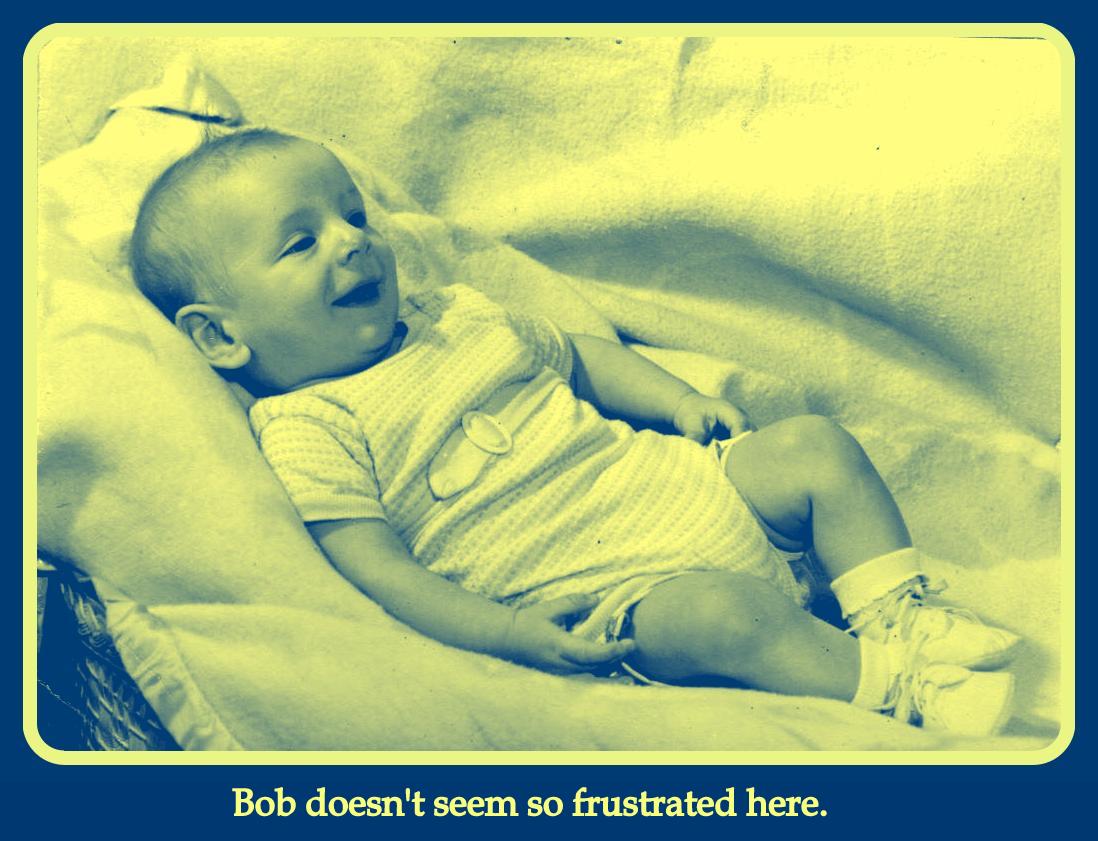
He's only a few months away from birth.
--Bob                                       


Thursday, October 1, 2015

A Mysterious Magnetic Force

"Why do reunions have to be so short?"

The Kerber family had a reunion recently. It was at a 4H camp; some of us brought campers or tents and others stayed in the 4H cabins, you know, five or six sets of bunk beds in a bare room. 

It’s the first reunion we’ve had in a while because we saw each other at the many family weddings that have occurred in the last few years. All 12 sibs were at the reunion, Dan through Gary. The spouses, too, and many of our kids and grandkids. They stole the show, the grandkids, who were just old enough to realize the fun it is to have a slew of cousins. Henry, my grandson, three and a half, said to his dad (Will), “Why do reunions have to be so short?”

Gray heads at early morning pinochle.
There were 62+/- of us, and we came from Ohio, Pennsylvania, Illinois, Kentucky, North Carolina, and Alabama. Most of our previous reunions were in the 1980s and ‘90s. Dad died in 1981, and shortly after that we had our first reunion, at a state park in Ohio. There were fewer Kerbers then, and we all stayed in cabins and did the usual reunion things—drink morning coffee, play cards, eat, watch the kids play, drink beer, sit around the campfire.

Our family has other ways of getting together besides reunions and weddings. Since 1986, the men in our family (brothers, brothers-in-law, and nephews over the age of 18, and a few male friends of the family) get together annually for a bachelor party. This started the year (brother) Fred and Julie were married. For the next ten or so years, in addition to playing cards and drinking beer, we’d sit around and talk about politics, ethics, and family happenings. After that, with the increase in numbers, the focus is more on playing cards, eating, and sitting around the campfire. 

So far, there have been only three funerals to bring us together. Nancy and Mark’s son
Family photos often attract an intruder.
Michael died at six months of age from a heart condition in 1984, and Dad in 1981 and Mom in 2008. At mom’s funeral everyone was there except Linda’s husband, Steve, who was sick at the time, and our niece Korie (John and Ellen’s oldest), who was living in Virginia at the time. It’s probably the last time that high percentage of Kerbers will ever get together again. Realizing this made me feel a little sad.

Why am I drawn back over and over to people whom I’ve known my entire life? What force pulls me to them? It’s not because we share the same beliefs or views or ways of life, for we are a diverse group of beings.
 Bob & Fred's birthday at a 1992 reunion

The magnetism that pulls us towards one another is family, of course, but why do families form such tight bonds? Bonds that conquer the divisions of our politics and our religions, bonds that surmount the physical distances between us. Not all families seem to have this same pulling towards each other. Are we Kerbers just lucky? 

Our family’s bonds weren’t formed just by us 12 siblings, although the (mom-enforced) caring we did for each other (older siblings feeding, dressing, reading to the younger ones) may have played a part in that closeness. These bonds were primarily instilled/incubated by our parents, George and Dorothy, who learned the value of closeness from their parents, who in turn learned it from …

This kind of family bonding probably goes all the way back to the days when families feared a saber-toothed tiger at the entrance of their cave. Mutual protection from the tigers drew them together. This part of the reason for family bonds is easy to understand. But is fear the only thing that draws us back to each other? Where do love and affection fit in? 

Mom and Dad taught us that 828 was our refuge, a place, both physical and non-physical, where we could find sustenance, comfort, and protection. That’s probably when the ties that bind us really took hold, and they continue to draw us back to one another. Family weddings are a fun way to stay connected, but it is the leisurely pace of multi-day reunions that allows me to feel those bonds, and to know that I am not alone.


--Bob
 

Monday, August 31, 2015

Killer singles hitter: One-Eyed NB


Our family had a reunion at a 4-H camp a couple of weekends ago. It’s been a number of years since we had one because of the many family weddings we’ve had lately. Mostly we did what people do at reunions—eat and yak.      

On Friday morning some of us were talking about the 828 blog—myself, my two sisters, Linda and Nancy, and my brother George and his wife, Muffy, our first guest blogger. We were talking about Obstacle Park, the last blog post about our playing whiffle ball in the backyard. Since Nancy (N or NB) was there, I quickly realized that I had left out an important piece of Kerber whiffle ball lore: Nancy had a unique batting stance that was long remembered in our family. I said I would rectify this by posting a comment to the 828 blog, as a sort of an addendum.
Batting right-handed, N used only one hand to grip the bat as she faced the pitcher straight on. She stood more like she was playing tennis rather than whiffle ball. She was a good hitter too, not hitting (m)any home runs but she did get a lot of singles and some doubles. She hit mostly ground balls, but being quick, she often beat out the throw to first.

Linda asked, “You know why she stood like that, don’t you?” There were ‘Nopes’ all around. “She swung that way because she had to face the pitcher square on to see the pitch. She’s practically blind in her left eye.”
Now it was ‘What!?’ all around. None of us knew that Nancy, who we thought we knew well, was one-eyed.

Why would you put a patch on this face?

Later that night around the campfire, I asked the rest of our siblings if they knew that N could see only out of her right eye. (She can detect movement and shapes with her bad eye.) Besides Linda, only Alan knew.
Then someone asked, “NB, Didn’t you wear an eye patch in high school?” All us boys remembered the patch, but we didn’t know that she couldn’t see out of her left eye.


Is this the face of a cheater?
In grade school she remembers cheating on the eye exam by peeking through her fingers. Tests were something she was expected to pass, and she did. By high school, someone somehow figured out that she had Amblyopia (lazy eye), and she wore a patch that was suppose to force her to use her bad eye. Of course, being of that ‘fit in’ high school age, she hated it. Alas, by tenth grade it was too late – you can’t teach old muscles new tricks.
This seems like an important fact for us Kerber boys not to have realized her problem at the time - a big deal. It suggests that we saw only the surface but not the interior. Were we just uncurious as to why she was wearing an eye patch? Did we think that the patch was cool and that was enough for us? As kids we really did see only N’s surface; as we became older, it was a pleasure getting to know her more deeply. (It has been a pleasure getting to know all my sibs more deeply.)

At times when I’m slip into my “If Only” game, I say things like, “If only I were born in an age when people questioned authority more easily, then I wouldn’t…” Thinking of N’s eye, I say, “If only someone would have caught the problem when it could have been corrected.” But I also think, “If only Nancy could have been born in a cooler age, maybe she’d have had better choices in eye patches.


 --Bob